
Introduction
Real estate math is the part of the licensing exam most students dread, and it’s also the most learnable. You don’t need advanced algebra. You need a short list of formulas, plenty of worked practice, and a clear picture of what the exam actually asks.
This guide gives you all three: the core formulas to memorize, practice questions solved step by step, and honest expectations about how much math shows up on test day. Work through it once to see the patterns, then again to build speed. By the end, you’ll know exactly which calculations to drill and how to check your answers before you sit the exam.
Table of Contents
- How Much Math Is on the Real Estate Exam?
- Real Estate Math Fundamentals: Percentages, Decimals, and Conversions
- Key Real Estate Math Formulas to Memorize
- Real Estate Math Practice Questions by Topic
- How to Study Real Estate Math for the Exam
- Real Estate Math Formula Cheat Sheet
- Frequently Asked Questions
- Conclusion: Your Real Estate Journey
Key Takeaways
- Math is a small, learnable share of the real estate exam, often roughly 5 to 20 questions, and the exact count varies by state.
- A short set of formulas covers most questions: loan-to-value, simple interest, gross rent multiplier, property tax, and discount points.
- Topic-by-topic practice makes each question type feel routine, from commission and taxes to prorations, interest, and investment math.
- A calculator is usually available: many states allow a basic non-programmable model or provide an on-screen one, so verify with your state commission.
- Percentage-to-decimal conversion, plus two constants (43,560 square feet per acre and 5,280 feet per mile), handles most measurement math.
How Much Math Is on the Real Estate Exam?
Math is a smaller, learnable share of the real estate exam than most students fear. It’s often roughly 5 to 20 questions, and the exact number varies by state, so verify with your state real estate commission. There’s no single national figure, because each state sets its own exam.
Math questions appear across both parts of the test. The national portion tends to cover finance, appraisal, and general calculations, such as loan-to-value, interest, and area. The state portion can add local tax or transfer-fee math tied to your market.
Vendors like PSI and Pearson VUE administer these exams under each state’s rules. The format and count you’ll see depend on where you test (state real estate commissions; PSI; Pearson VUE).
The count feels bigger than it is because math questions are spread out and often word-heavy. A single question may bury one calculation inside a paragraph of setup. Read slowly, pull out the numbers, and pick the formula before you touch the calculator.
For a fuller picture of the whole test, read our guide to how hard the real estate exam really is. It helps you decide how much study time the math deserves.
Can You Use a Calculator on the Exam?
Yes, in many states you can. Calculator policy varies by state: some let you bring a basic, non-programmable calculator, and others provide an on-screen calculator inside the testing software. Massachusetts and Pennsylvania, for example, provide an on-screen calculator during the exam (Massachusetts Board of Registration of Real Estate Brokers and Salespersons; Pennsylvania State Real Estate Commission).
Programmable calculators, graphing calculators, and phones are generally not allowed. Confirm your state’s rule before test day, since policies change (check with your state real estate commission). For a state-specific example, our Pennsylvania real estate exam guide walks through what to expect at the test center.

Most exam math mirrors the everyday calculations agents already run.
Real Estate Math Fundamentals: Percentages, Decimals, and Conversions
Most real estate math questions come down to one skill: moving between percentages, decimals, and fractions. Convert the percentage to a decimal first, then multiply. A 6% commission rate becomes 0.06 (move the decimal two places left), and a 1.5% tax rate becomes 0.015.
To go the other way, multiply by 100: 0.075 becomes 7.5%. Fractions follow the same logic: one-half is 0.5 or 50%, and one-quarter is 0.25 or 25%. Make this conversion automatic and half the exam’s math stops feeling like math.
One more habit saves points: follow the order of operations. Handle what’s inside parentheses first, then multiply and divide, then add and subtract. On a question like 350,000 x (1 – 0.02), solve 1 – 0.02 = 0.98 first, then multiply to get $343,000.
Some questions ask “what percent” instead of “how much.” To find what percent one number is of another, divide the part by the whole. If a $9,000 down payment is part of a $300,000 price, then 9,000 / 300,000 = 0.03, or 3%. That single move answers a surprising share of exam math.
Real Estate Math Terms Worth Knowing
A few definitions clear up most confusing questions. Learn these before you drill the formulas.
- Appraised value: a licensed appraiser’s estimate of a property’s worth, used to size a loan.
- Assessed value: the value a local assessor assigns for property taxes, often lower than market value.
- Principal: the amount borrowed, before interest.
- Net operating income (NOI): annual income from a property after operating expenses, before loan payments.
- Proration: dividing a shared cost, like taxes, between buyer and seller by the closing date.
Measurement, Area, and Acreage
Land questions rely on two constants worth memorizing: 43,560 square feet equals 1 acre, and 5,280 feet equals 1 mile. Area of a rectangular lot is length times width.
Try one: a lot that measures 200 feet by 300 feet covers 60,000 square feet. To convert to acres, divide by 43,560: 60,000 / 43,560 = about 1.38 acres. For an irregular lot, split it into rectangles, find each area, then add them together.
Front feet measure the side of a lot that faces the street, which matters for pricing and some assessments.
Price-per-unit questions build on the same math. If that 1.38-acre lot sells for $207,000, the price per acre is 207,000 / 1.38 = $150,000. If a builder pays $600 per front foot for a lot with 80 feet of frontage, the frontage cost is 80 x 600 = $48,000.
Key Real Estate Math Formulas to Memorize
Memorize these formulas and you can solve most exam math. Write each one on a flashcard and practice until you can recall it without looking.
- Loan-to-Value Ratio (LTV): LTV = (Loan Amount / Appraised Value) x 100
- Simple Interest: Simple Interest = Principal x Rate x Time
- Gross Rent Multiplier (GRM): GRM = Property Price / Gross Annual Rent
- Property Tax: Property Tax = Assessed Value x Tax Rate
- Discount Points: One point = 1% of the loan amount
The core formulas all revolve around price, value, and rate.
Discount points work off the loan amount, so find the loan first, then take the percentage. Each point is prepaid interest that lowers the loan’s rate, so borrowers trade an upfront cost for smaller monthly payments.
Here’s a worked LTV example. A buyer borrows $240,000 on a home appraised at $300,000. LTV = (240,000 / 300,000) x 100 = 80%.
Lenders read that 80% as the risk level. An LTV at or below 80% often lets the buyer skip private mortgage insurance.
The gross rent multiplier works the same quick way. If a rental sells for $360,000 and brings in $30,000 in gross annual rent, GRM = 360,000 / 30,000 = 12. A lower GRM signals a faster payback, so investors use it to compare similar properties at a glance.
Simple interest rounds out the set. On a $20,000 loan at 6% for 3 years, Simple Interest = 20,000 x 0.06 x 3 = $3,600. Keep the rate as a decimal and the time in years, and the formula stays reliable.
Real Estate Math Practice Questions by Topic
The fastest way to pass the math portion is to practice by topic until each type feels routine. Work each example below with a pencil first, then check the steps. Every answer uses arithmetic you can verify yourself.
As you practice, label every question by type before you solve it. Naming the category (“this is a proration”) points you to the right formula and stops the panic that costs students easy points. The examples below are grouped the same way so you can rehearse one type at a time.

Practicing by topic turns these calculations into second nature on the job.
Commission
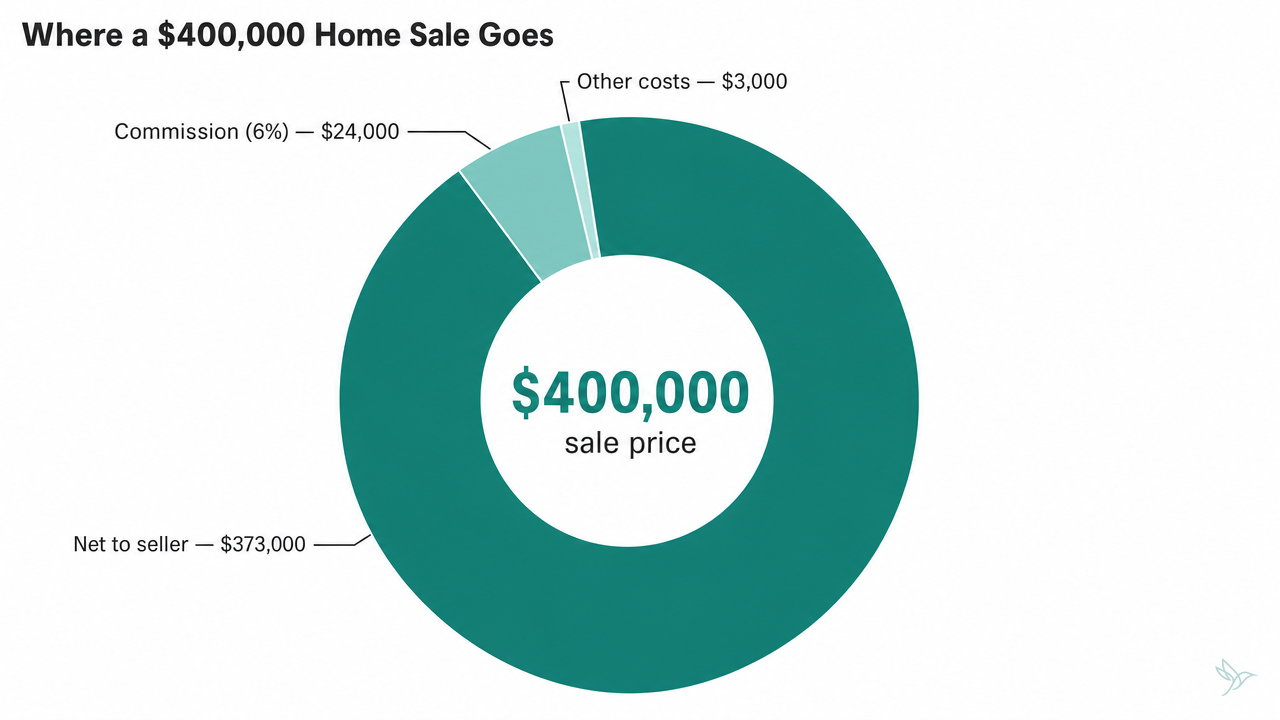
Where a $400,000 home sale goes: commission, other costs, and net to seller.
Commission questions ask you to find a dollar amount, a rate, or a split. Find the total commission first, then divide it.
Basic split: A home sells for $400,000 at a 6% commission. Total commission = 400,000 x 0.06 = $24,000. Split 50/50, each side earns $12,000.
Broker/agent split: An agent’s side earns $12,000 and the agent keeps 70% after the broker’s cut. The agent earns 12,000 x 0.70 = $8,400, and the broker keeps $3,600.
Net to seller: Start with a $400,000 sale, $24,000 commission, and $3,000 in other costs. Net to seller = 400,000 – 24,000 – 3,000 = $373,000.
Working backward: A seller needs $373,000 net after a 6% commission. Divide the net by (1 – 0.06): 373,000 / 0.94 = about $396,809 sale price.
Net listing: A seller wants $380,000 and lets the agent keep anything above it. If the home sells for $400,000, the commission is 400,000 – 380,000 = $20,000.
Watch the wording on split questions. “Split 50/50” means each side takes half of the total commission. A “70/30 split” usually describes how one side divides its share between agent and broker.
Check any commission math with our real estate commission calculator. To see how splits shape take-home pay, read how real estate commission and earnings actually work.
Property Tax and Prorations
Property tax questions test the basic formula plus a few mechanics. Read carefully to see which value and rate the question gives you.
Basic tax: A home has an assessed value of $350,000 and a tax rate of 1.5%. Property Tax = 350,000 x 0.015 = $5,250 per year.
Assessed vs. market value: Market value is what a buyer would pay. Assessed value is the figure the local assessor uses for taxes, and it’s often lower.
Mill/millage rate: A mill is one dollar of tax per $1,000 of assessed value. A rate of 20 mills equals 0.020, so $350,000 owes $7,000.
Exemptions: Some owners qualify for exemptions (for example, a homestead exemption) that reduce the taxable value before you apply the rate.
Proration splits a yearly cost between buyer and seller at closing. The seller pays for the days they owned the property, and the buyer pays the rest. Suppose annual tax is $5,250 and the buyer takes ownership on day 200 of the year.
Using a 365-day year, the daily rate is 5,250 / 365 = about $14.38. The seller owes 199 days x 14.38 = about $2,862, and the buyer covers the balance. Some questions use a 360-day year (a 30-day-month convention) instead, and the question always tells you which method to use.
Try the same figures with the 360-day method. The daily rate becomes 5,250 / 360 = about $14.58, and 199 days gives the seller about $2,902. The gap between the two methods is small, but the exam expects you to use whichever one the question names.
Interest, LTV, and Discount Points
Financing questions reward the formulas you memorized above. Set up each one before you reach for the numbers.
- Simple interest: A $10,000 loan at 5% for 2 years earns Interest = 10,000 x 0.05 x 2 = $1,000.
- LTV: A buyer borrows $240,000 on a $300,000 appraisal. LTV = (240,000 / 300,000) x 100 = 80%.
- Discount points: One point equals 1% of the loan amount. On a $250,000 loan, 2 points cost 250,000 x 0.02 = $5,000.
Points questions sometimes ask about the trade-off. If those 2 points save a buyer $120 a month, the break-even is 5,000 / 120 = about 42 months. A buyer who plans to keep the loan past that point comes out ahead, which is the kind of reasoning the exam rewards.
Mortgage Payments
Monthly payment questions look intimidating but follow one formula. For a $300,000 mortgage over 30 years at a 5% annual rate, use M = P[i(1+i)^n] / [(1+i)^n – 1].
Here P is the principal, i is the monthly rate (0.05 / 12), and n is the number of payments (360). The monthly principal and interest works out to about $1,610.46. You’ll rarely compute this by hand, since a calculator or amortization table handles it.
You’re more likely to see the simpler pieces of this math. A question might give the monthly payment and ask for the yearly total: 1,610.46 x 12 = about $19,326.
Another asks how much of the first payment is interest. Multiply the balance by the monthly rate: 300,000 x (0.05 / 12) = $1,250 interest, leaving about $360.46 toward principal.
Investment Math: Cap Rate and Cash-on-Cash
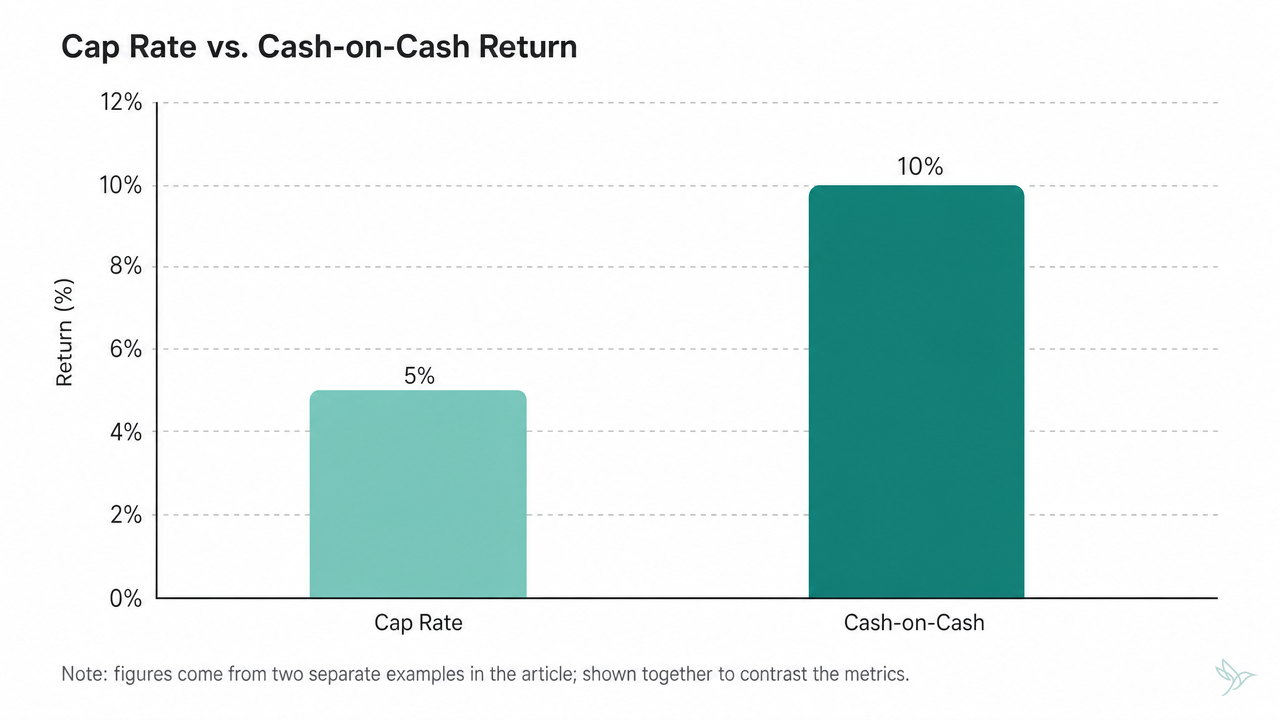
Cap rate (5%) versus cash-on-cash return (10%). Figures come from two separate examples, shown together to contrast the metrics.
Investment questions show up on the exam too, so practice them like any other type.
- Cap rate: A property produces $25,000 in net operating income (NOI) on a $500,000 price. Cap Rate = 25,000 / 500,000 = 5%.
- Cash-on-cash return: An investor puts $100,000 down and earns $10,000 in pre-tax cash flow. Cash-on-cash = 10,000 / 100,000 = 10%.
Keep the two straight. Cap rate divides income by the full property price, so it measures the asset. Cash-on-cash divides income by the actual cash invested, so it measures your return after financing.
Exam questions often give both figures to see whether you pick the right denominator.
Profit, Loss, and Percentage Change
Percentage-change questions ask how much a value rose or fell. Subtract, then divide by the original amount.
Worked example: an owner buys a property for $250,000 and sells it for $300,000. Profit = 300,000 – 250,000 = $50,000. Percentage gain = 50,000 / 250,000 = 20%.
The same formula handles a loss: a sale at $225,000 is a 25,000 / 250,000 = 10% loss.
Want more reps? Work through a free real estate practice exam and time yourself on the math items.
How to Study Real Estate Math for the Exam
You learn real estate math by doing it, not by rereading formulas. Use these techniques to build recall and speed.
- Break it down: master one topic at a time (commission, then taxes, then interest) before you mix them.
- Use flashcards: put the formula on one side and a worked example on the other.
- Teach someone else: explaining a proration out loud exposes the steps you don’t yet know.
- Simulate the exam: take timed practice tests so the clock stops rattling you on test day.
- Space your sessions: study math in short daily blocks instead of one long cram before the test.
- Track your misses: keep a running list of the question types you get wrong and drill those first.
Time your practice runs so the clock feels routine on test day.
Give math its own study block rather than mixing it with vocabulary and law. Twenty focused minutes a day beats a weekend marathon, because recall improves when you revisit a formula several times across a week. Rework any question you miss until you can solve it from a blank page.
Write out each step, even when a calculator does the arithmetic. Setup errors, not math errors, cause most missed questions, so a clear layout catches mistakes before they cost you points. On test day, that habit turns word problems into a quick, repeatable routine.
Practice exams matter most because they show which question types still trip you up. Our guide on how to use practice exams to improve your score shows how to review your misses, not just your score.
Colibri’s real estate exam prep is powered by CompuCram and includes simulated exams, flashcards, and a readiness assessment. You know you’re ready before test day instead of hoping you are. It’s backed by our Pass or Don’t Pay Guarantee: if you don’t pass, you don’t pay.
Explore Colibri’s real estate exam prep to start drilling the math with feedback on every answer. The readiness assessment flags the exact topics where you’re still shaky. You can spend your last week on prorations or points instead of reviewing what you already know.
Get a FREE Practice Exam and see where your math stands right now.
Real Estate Math Formula Cheat Sheet
Use this table as your last-minute review. Cover the middle column and try to recall each formula from the name alone. When you can do that for every row, your real estate math is exam-ready.
Formula | Calculation | When to Use It |
|---|---|---|
Loan-to-Value (LTV) | (Loan Amount / Appraised Value) x 100 | Measure loan risk and PMI thresholds |
Simple Interest | Principal x Rate x Time | Find interest owed on a basic loan |
Gross Rent Multiplier (GRM) | Property Price / Gross Annual Rent | Compare income properties quickly |
Property Tax | Assessed Value x Tax Rate | Calculate annual tax owed |
Discount Points | One point = 1% of the loan amount | Price prepaid interest that lowers the rate |
Commission | Sale Price x Commission Rate | Find total commission, then split it |
Cap Rate | NOI / Property Price | Gauge an income property’s return |
Cash-on-Cash | Annual Pre-Tax Cash Flow / Cash Invested | Measure return on cash put in |
Percentage Change | (New Value – Old Value) / Old Value | Find profit, loss, or growth |
Area | Length x Width | Measure a rectangular lot or building |
Frequently Asked Questions
How Much Math Is on the Real Estate Exam?
Math is a small share of the exam, often roughly 5 to 20 questions, and the exact count varies by state (state real estate commissions). Check your state’s exam outline to confirm the number where you’ll test.
Is Real Estate Math Hard?
Most real estate math uses basic arithmetic: percentages, multiplication, and division, not advanced algebra. Once you memorize a handful of formulas and practice by topic, the questions become predictable.
Can You Use a Calculator on the Real Estate Exam?
Often, yes, but policy varies by state, and many states allow a basic non-programmable calculator or provide an on-screen one. Massachusetts and Pennsylvania, for example, supply an on-screen calculator (Massachusetts Board of Registration of Real Estate Brokers and Salespersons; Pennsylvania State Real Estate Commission). Verify with your state commission before test day.
What Real Estate Math Formulas Should I Memorize?
Start with loan-to-value, simple interest, gross rent multiplier, property tax, commission, and discount points. Add cap rate and percentage change for investment and profit questions.
What Kind of Math Do Real Estate Agents Use?
Agents mostly use percentages and simple arithmetic: commission splits, property taxes, prorations, loan-to-value ratios, and area measurements. The exam tests the same calculations you’ll run in daily practice.
Conclusion: Your Real Estate Journey
Real estate math isn’t the wall it feels like. It’s a short list of formulas, a set of question types you can rehearse, and a calculator you’ll likely have on test day. Drill each topic until the steps come without hesitation, and the math portion turns into free points.
More than 500,000 students have trusted Colibri Real Estate to help them get licensed. Our Pass or Don’t Pay Guarantee means you don’t pay if you don’t pass. Start with CompuCram-powered exam prep and see the details of our Pass or Don’t Pay promise.
Your next concrete step: pick one topic above, work three practice questions today, and check each answer. Master Real Estate FREE Starter Kit Here.

Sources
- Massachusetts Board of Registration of Real Estate Brokers and Salespersons. “Board of Registration of Real Estate Brokers and Salespersons.” Mass.gov. https://www.mass.gov/orgs/board-of-registration-of-real-estate-brokers-and-salespersons
- Pennsylvania State Real Estate Commission. “State Real Estate Commission.” PA.gov, Bureau of Professional and Occupational Affairs. https://www.pa.gov/agencies/dos/department-and-offices/bpoa/boards-commissions/real-estate-commission
Related Content
- What is agency in real estate? A complete guide to agent representation
- How to use real estate practice exams to actually improve your score
- Failed the real estate exam? Here’s how to adjust your study strategy
- Master the Illinois Real Estate Exam with Practice Tests
- Master Your Virginia Real Estate Exam with Practice Resources
- AI Meets ROI: Transforming Your Real Estate CRM Into a Growth Engine


