
Most people need 8 to 12 weeks and 60 to 100 hours to study for the real estate exam. If you’re asking how long should you study for the real estate exam, the honest answer depends on your background, your schedule, and your state.
Passing the licensing exam is the step between your coursework and your license. This guide gives you a clear range, a week-by-week timeline, tiered plans, and concrete readiness signals so you can book your test with confidence.
Table of Contents
- Understanding the Real Estate Exam
- Factors Influencing Study Duration
- Recommended Durations: How Long Should You Study for the Real Estate Exam
- Effective Study Strategies
- Practice Exams and Readiness Benchmarks
- Tips for Exam Day Success
- Common Reasons for Failing and Retake Policies
- Frequently Asked Questions
- Start Your Real Estate Journey With Confidence
Key Takeaways
- Plan for 2 to 3 months: most candidates study 60 to 100 hours across 8 to 12 weeks (Colibri Real Estate guidance).
- Account for your background: those with related experience may need 6 to 8 weeks, while complete beginners should plan 10 to 12 weeks.
- Quality beats quantity: consistent, focused sessions with practice tests and flashcards work better than cramming.
- State requirements vary: some states run longer, more complex exams, so check your state’s exam format and content.
- Working full-time: plan shorter daily sessions to protect retention and avoid burnout.
- Know when you’re ready: aim for consistent 80%+ scores on timed practice exams before you book your test date.
Understanding the Real Estate Exam
Before you build a schedule, it helps to know what you’re preparing for. Real estate licensing exams use multiple-choice questions that cover both national and state-specific content.
Most exams run 100 to 150 questions. The time limit is usually 2.5 to 4 hours. The exact count and format vary by state and by the testing vendor your state assigns, such as PSI Services or Pearson VUE. In California, for example, the salesperson exam runs 150 questions over 3 hours (California Department of Real Estate).
Your questions cover real estate law, property ownership, financing, valuation, and contracts. You’ll also face math like commission, loan-to-value, and proration.
Match your study time to how the exam is weighted. Your state’s exam outline shows how many questions each topic carries, so give the heaviest-weighted areas the most review time. To see what’s tested, read our guide on how hard the real estate exam really is.
The time limit means speed matters as much as knowledge. Colibri’s Exam Prep tools include timed simulated exams that follow the real state format, so you can practice your pacing before test day.

Set up a focused, distraction-free study space before you build your schedule.
Factors Influencing Study Duration
Several factors decide how long you need to prepare. Your existing commitments come first: full-time work, family responsibilities, or other obligations naturally extend your timeline.
Your prior experience matters too. If you’ve worked in property management, mortgage lending, or construction, some concepts will feel familiar and cut your study time. Complete newcomers should plan for fuller preparation.
Your learning style shapes how fast you absorb material. Visual learners lean on diagrams and charts, while auditory learners prefer recorded lectures or study groups. Choose materials that fit how you learn best.
Reading speed, your study environment, and decision fatigue also affect your pace. If you read slowly or study in a noisy space, budget extra hours. Long sessions drain focus, so shorter, distraction-free blocks protect the quality of each hour.
State complexity adds time as well. States with heavier legal frameworks or unique regulations need more review beyond the national content.
Timing against your coursework helps too. Begin dedicated exam study as you near the end of your pre-licensing classes, while the material is fresh. Reviewing as you go, instead of waiting until the course ends, shortens the prep you’ll need later.
For the full path to your license, see how long it takes to get a real estate license. Note that longer isn’t always better. Stretching prep across many months can erode retention, so a focused 8-to-12-week window usually beats a drawn-out timeline.
Recommended Durations: How Long Should You Study for the Real Estate Exam
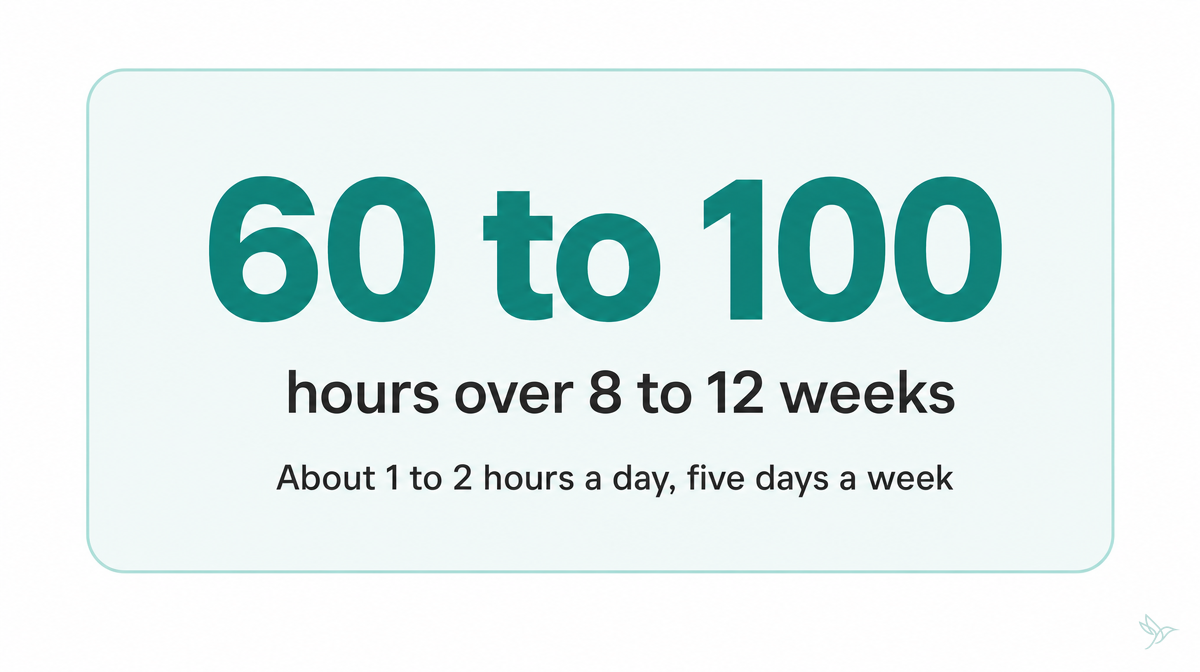
Recommended study time: 60 to 100 hours over 8 to 12 weeks
When you plan how long you should study for the real estate exam, our instructors recommend 60 to 100 hours. Spread that across 8 to 12 weeks. That window gives you time for content review, practice testing, and retention without overwhelming your schedule.
A realistic schedule is 1 to 2 hours of focused study, five days a week. Reserve weekends for longer practice exams or review of tougher topics.
Average Study Time for the License Test
A useful benchmark is about 80 hours of study, which many first-time passers report. That’s roughly 8 hours a week over 10 weeks, a pace most people can fit around existing commitments.
That schedule also builds in repetition and review, which drive long-term retention. Consistency across those 10 weeks matters more than any single marathon session.
Week-by-Week Study Timeline
Here’s a 10-week plan you can adapt to your own start date. The phases overlap on purpose, so practice testing begins before your content review is fully finished.

Map your weeks in advance so content review, practice tests, and final review all get their time.
Phase | Weeks | Focus | Weekly hours |
|---|---|---|---|
Foundations | Weeks 1 to 2 | Learn core vocabulary and fundamental concepts | 8 to 10 |
Content review | Weeks 3 to 6 | Work through content areas in order of exam weighting | 8 to 10 |
Applied practice | Weeks 5 to 8 | Add timed practice exams and target weak areas | 8 to 12 |
Final review | Weeks 9 to 10 | Full simulations and focused review of missed topics | 10 to 12 |
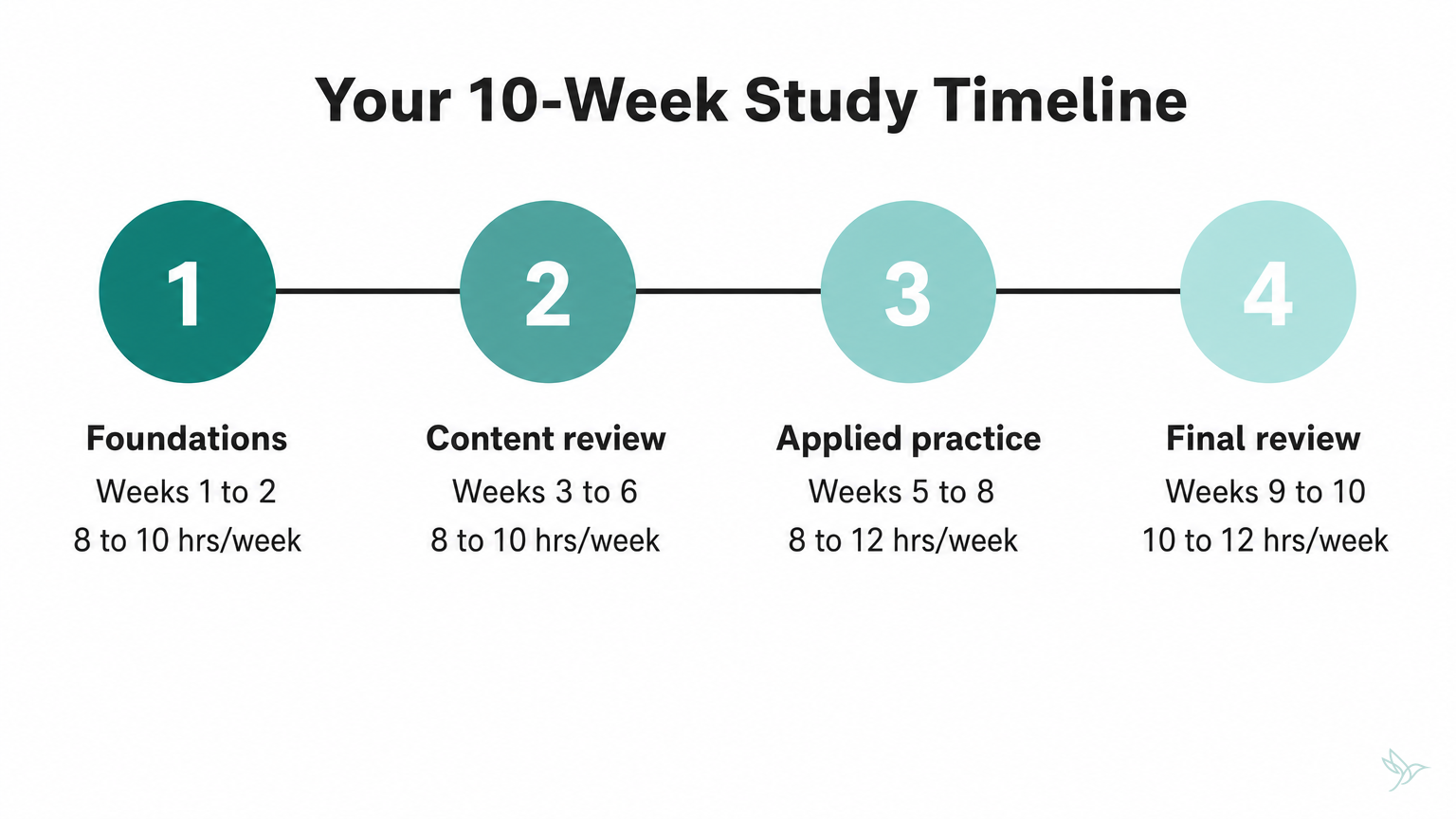
Your 10-Week Study Timeline
Tiered Study Plan Options
Not everyone needs the same schedule. Pick the plan that matches your experience and how much structure you want.
Plan | Timeline | Weekly hours | Best for |
|---|---|---|---|
Accelerated | 6 to 8 weeks | 12 to 15 | Candidates with related real estate or finance experience |
Standard | 10 to 12 weeks | 8 to 10 | Most first-time candidates studying around a job |
Course-supported | 8 to 12 weeks | 6 to 10 plus live sessions | Those who want live instructor Q&A and a set schedule |
Weekly Study Hours by Plan (top of each plan’s range)
If you want the structure of a set schedule, Colibri’s Exam Prep courses pair self-paced study with live instructor Q&A and Exam Crammer webinars. You get flexibility without studying alone.
State-Specific Study Time Considerations
Exam requirements differ by state, and that changes your timeline. The California exam includes 150 questions and covers extensive state regulation (California Department of Real Estate), so many candidates budget 12 to 14 weeks of study (Colibri Real Estate guidance).
Texas requires 180 hours of pre-licensing education (Texas Real Estate Commission). It also leans heavily on state law and contracts, which adds review time. Rather than assume a national rule, check your own state’s real estate authority for its exact question count, time limit, and requirements.
Effective Study Strategies
Start with a diagnostic. Take a full-length practice exam in your first week to set a baseline, then steer your study hours toward the topics you missed. This approach keeps you from over-studying what you already know.
Build a structured schedule that breaks topics into daily sessions. Consistency beats intensity for exam preparation.
Use active learning instead of passive rereading. Flashcards, practice questions, and teaching a concept out loud surface knowledge gaps early. For more techniques, see our proven study tips for passing the real estate exam.
Study Plan for Working Full-Time

Short, consistent sessions around work protect retention better than marathon cramming.
Balancing a full-time job with exam prep takes realistic expectations. Extend your timeline to 12 to 16 weeks so your schedule stays sustainable.
Early-morning sessions of 30 to 60 minutes before work often land best. Your mind is fresh and interruptions are rare.
Use weekend blocks for longer review sessions and practice exams. Avoid marathon sessions that lead to burnout or information overload.
Practice Exams and Readiness Benchmarks
Practice exams are the most valuable tool in your preparation. They show your knowledge level, build familiarity with question formats, and grow your confidence. Work them in throughout your study period.
Begin practice exams after you’ve reviewed about 60% of the content. That timing surfaces weak areas while you still have time to fix them. Take them under timed conditions to mirror the real experience.
Review every question, including the ones you got right. Knowing why an answer is correct or wrong strengthens your comprehension and prevents repeat mistakes.
How to Know You’re Ready
Use concrete signals, not a gut feeling, to decide when to book your test. You’re likely ready when you can check off these benchmarks:
Use concrete readiness signals — not a gut feeling — to decide when to book.
- You consistently score 80% or higher on full-length, timed simulations.
- Your scores stay stable across several attempts, not just one lucky run.
- You can explain why each missed answer was wrong, instead of memorizing answers.
- You finish the full exam within the time limit with margin to review.
Colibri’s practice-exam approach and readiness assessment track exactly these signals. Our Pass or Don’t Pay Guarantee also ties eligibility to meeting practice-exam readiness requirements. That keeps you from booking the state test too early.
Tips for Exam Day Success
Strong exam performance goes beyond content knowledge. Arrive well-rested, having slept the night before, because fatigue impairs concentration and decision-making.
Manage your time during the test. Pace yourself so you can answer every question without rushing the final sections. If you’re unsure, make an educated guess and move on rather than stalling.
Read each question carefully. Words like “not,” “except,” or “always” can change the meaning, so a few extra seconds prevents careless errors.
Common Reasons for Failing and Retake Policies
Knowing why candidates fail helps you avoid the same traps. Inadequate study time is the leading cause, followed by poor time management during the test. Many candidates underestimate the breadth of material or skip timed practice.
Overconfidence in familiar topics leads to uneven preparation. Some candidates over-study strengths while neglecting weak areas. A balanced approach across all content areas raises your odds.
Signs You Should Delay Your Exam
Booking too early can cost you a pass. Consider pushing your date if any of these apply:
- Your practice scores are inconsistent or still below 80%.
- Your vocabulary recall is shaky under time pressure.
- You can’t finish a timed simulation within the limit.
- You’re relying on memorized questions instead of understanding concepts.
To gauge the time you’ll need, look at your state’s pass rates and talk with recent test-takers. Delaying a few weeks to hit your benchmarks protects your goal of passing on the first try.
If you don’t pass the first time, don’t be discouraged. Retake rules are set by each state’s real estate authority: most states allow retakes after a waiting period, and many let you retake only the failed portion. Learn how many times you can retake the real estate exam to understand your options.
Pass rates vary widely by state and by exam portion, and no single national body publishes one figure. In California, for example, pass-rate data comes from the state licensing authority (California Department of Real Estate). See our overview of real estate exam pass rates to set expectations.
Frequently Asked Questions
How Long Should You Study for the Real Estate Exam?
Most candidates study 60 to 100 hours over 8 to 12 weeks (Colibri Real Estate guidance). That’s about 1 to 2 hours a day, five days a week. Consistent sessions beat cramming.
How Many Hours a Day Should You Study?
Aim for 1 to 2 hours a day, five days a week, with longer weekend blocks for practice exams. Consistency protects retention better than occasional long sessions.
How Many Questions Are on the Exam, and How Long?
Most state exams include 100 to 150 questions with a limit of about 2.5 to 4 hours. The exact count and time vary by state and by the testing vendor your state assigns, such as PSI Services or Pearson VUE. In California, the salesperson exam runs 150 questions over 3 hours (California Department of Real Estate). Check your state’s real estate authority for details.
What Score Do You Need to Pass?
Passing scores are typically around 70% to 75% on each portion, but they vary by state (California Department of Real Estate). Confirm the passing score with your own state’s authority before test day.
How Do I Know I’m Ready to Take the Exam?
You’re likely ready when you consistently score 80% or higher on full-length timed simulations and can explain why each missed answer was wrong. Stable scores across several attempts are a strong signal.
What Happens if I Fail?
Retake rules are set by each state’s real estate authority: most states allow retakes after a waiting period, and many let you retake only the failed portion. Review your missed topics, then rebook once your practice scores are consistent.
Start Your Real Estate Journey With Confidence
How long you study depends on your circumstances, but most successful candidates dedicate 8 to 12 weeks to focused preparation. Build your schedule around consistent sessions, phased review, and timed practice exams.
Let your readiness benchmarks, not the calendar, decide when to book. When you’re scoring 80%+ on timed simulations and can explain your misses, you’re ready to schedule with confidence.
Colibri’s exam prep courses give you structured support and a lower-risk start, backed by our Pass or Don’t Pay Guarantee. Your next step is simple: choose a plan, start your phased schedule, and track your practice scores toward that 80% mark.
Master Real Estate FREE Starter Kit Here

Sources
- California Department of Real Estate. “Taking the Exam.” California Department of Real Estate, https://www.dre.ca.gov/Examinees/TakingExam.html. Accessed 20 Aug. 2026.
- Texas Real Estate Commission. “Become a Real Estate Sales Agent.” Texas Real Estate Commission, https://www.trec.texas.gov/become-licensed/sales-agent. Accessed 20 Aug. 2026.
Related Content
- What is agency in real estate? A complete guide to agent representation
- How to use real estate practice exams to actually improve your score
- Failed the real estate exam? Here’s how to adjust your study strategy
- Real Estate Math Practice Questions to Sharpen Your Skills
- Master the Illinois Real Estate Exam with Practice Tests
- Master Your Virginia Real Estate Exam with Practice Resources


