
If you’re weighing a real estate career, you’re probably asking, “how much does a real estate agent make per sale?” The answer starts with commission, because that’s how you’ll likely be paid. As a new licensee, understanding the basics is crucial. While a few brokerages are moving to a salary-based structure, most still operate on a commission-based model. This means your income is directly tied to your performance and the all-important commission split. If you’re just getting started, our pre-licensing courses cover these fundamentals from day one.
While the real estate compensation landscape is evolving, particularly with recent industry changes such as the NAR settlement, the potential for financial success remains strong. Whether you’re just starting your journey or looking to advance your career, mastering these financial mechanics is the first step toward your success.
Table of Contents
- How Much Does a Real Estate Agent Make Per Sale?
- Negotiate Real Estate Commission Splits
- Breakdown of Commission Distribution
- Who Pays the Real Estate Commission?
- Estimate Your Earnings by Home Price and Career Stage
- Understanding Average Commission Rates and Regional Variations
- Calculate Real Estate Commission Based on Sales
- Increase Your Real Estate Commission Salary by Learning More
- Recent and Potential Changes in Commission Models
- Frequently Asked Questions and Common Concerns
- Achieve Your Goals in Real Estate with Colibri Real Estate School
Key Takeaways
- Diverse Compensation Models: Real estate compensation models vary widely, with commission-based structures being the most common.
- Performance-Based Earnings: Your earnings are directly linked to your performance and the commission split agreed upon with your brokerage.
- Industry Evolution: Understanding the impact of industry changes, such as the NAR settlement, is essential for adapting and thriving in a shifting market.
- Foundation for Success: Mastering the financial aspects of real estate is a crucial step in building a successful career.
- Long-Term Growth: Continuous improvement and staying informed are key to maximizing your income potential and achieving long-term growth.
How Much Does a Real Estate Agent Make Per Sale?
On a typical deal, a real estate agent earns about 2.5% to 3% of the sale price on their side of the transaction, a per-side range reported by Bankrate’s guide to agent fees and commissions. On a $500,000 home, that’s roughly $12,500 to $15,000 in gross commission before your brokerage split, taxes, and expenses.
Your actual take-home depends on your split and costs. The full breakdown below walks you through exactly where the money goes, step by step.
Step 1: Negotiate Real Estate Commission Splits
You’ll typically negotiate your commission split with your brokerage when you sign on with them. Initially, most brokerages offer a standard commission split to new agents. Once you’ve got some experience under your belt or reach a certain production threshold, your broker will usually increase your split.
Your split is negotiated when you partner with a brokerage.
Types of Commission Splits
There are several ways brokerages structure their payouts, and understanding them helps you choose the right fit for your goals:
- Traditional Split (e.g., 60/40 or 70/30): This is the most common model, in which the brokerage retains a percentage of your commission to cover overhead, training, and support. For example, on a 70/30 split, you keep 70% of the gross commission.
- Graduated Split: Some brokerages offer an incentive-based model where your share increases as you earn more. You might start at 50/50, but once you earn $50,000 in brokerage commissions, you move to an 80/20 split.
- 100% Commission Model (Cap Model): In this scenario, you keep 100% of your commission but pay a monthly desk fee or a transaction fee. Often, these brokerages have a “cap” (a limit on how much you pay the brokerage annually). Once you hit that cap (e.g., $12,000), everything else is yours to keep.
Negotiation Strategies for New Agents
Don’t be afraid to ask for what you’re worth but remember that value is a two-way street. If a brokerage offers a lower split but provides free leads, mentorship, and marketing costs, that might be worth more to your early career than a higher split with zero support.
Related Article: How to Find the Best Brokerage to Work For as a New REALTOR
Breakdown of Commission Distribution
To truly understand your earnings, you need to follow the money. How does a single transaction break down?
The Commission Split
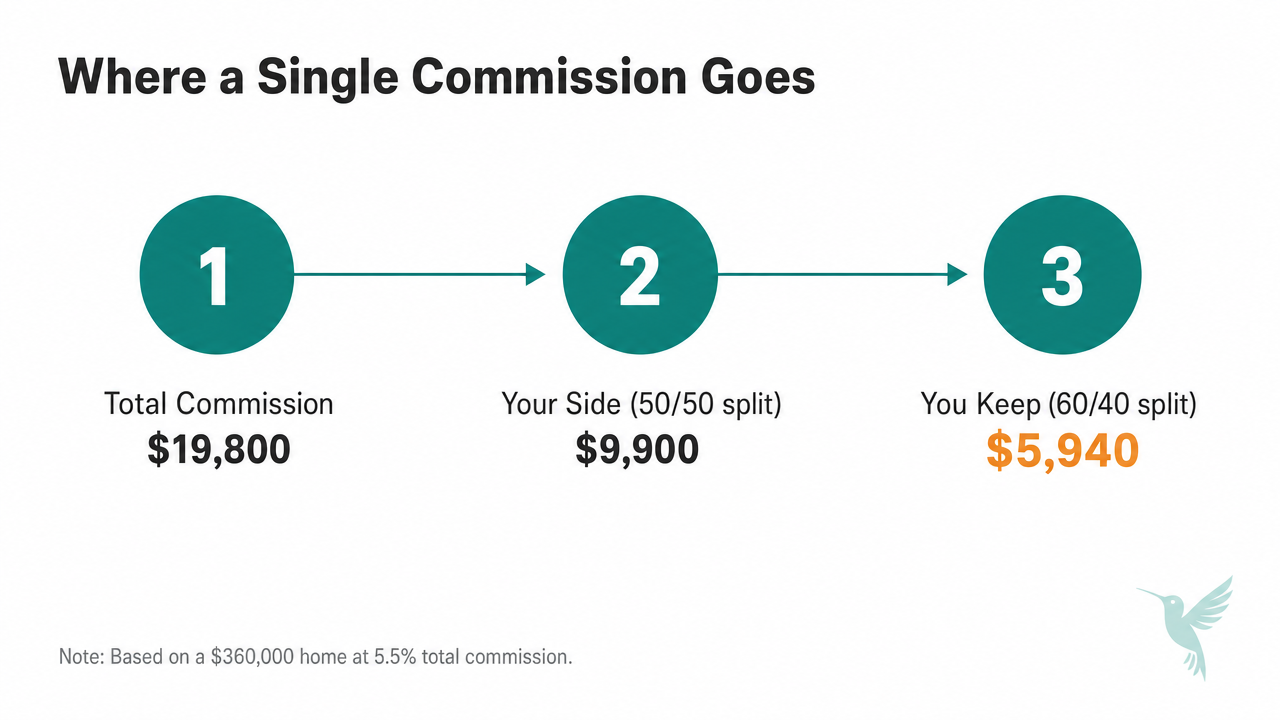
Let’s look at a hypothetical sale. Say you sell a $360,000 home (close to the national median).
- Total Commission: Typically, the total commission is around 5 to 6% of the sales price. On a $360,000 home at 5.5%, that is $19,800.
- Listing vs. Buyer’s Agent: This total is usually split between the listing agent fee and the buyer’s agent fee. A common split is 50/50, meaning each side gets $9,900.
- Brokerage Split: Now, you share your $9,900 with your broker. If you are on a 60/40 split, you keep $5,940.
Note: As an independent contractor, you are responsible for your own taxes and business expenses. The number above is your gross income before these deductions.
Dual Agency
If you represent both the buyer and the seller, known as dual agency, you may be entitled to the full commission (both sides). However, this is illegal in some states and heavily regulated in others due to the challenge of representing both parties’ best interests fairly.
Who Pays the Real Estate Commission?
Traditionally, the seller pays the total commission out of the sale proceeds, then shares it with the buyer’s agent. Following the 2024 NAR settlement, that arrangement now has more flexibility. Buyer’s-agent fees can be paid directly by the buyer or negotiated as a seller concession. Either way, the commission is paid at closing and deducted from the transaction proceeds, not billed separately upfront. For a closer look at how agents actually collect their pay, read our guide on how realtors get paid.
Estimate Your Earnings by Home Price and Career Stage
Your income potential is limitless, but it helps to have realistic benchmarks. According to Clever Real Estate’s 2026 survey, the national average total commission rate hovers around 5.5%, though this varies by market.
Here is a quick look at potential earnings based on home prices (assuming a 2.8% commission share for your side of the deal):
- $250,000 Sale: $7,000 Gross Commission
- $500,000 Sale: $14,000 Gross Commission
- $1,000,000 Sale: $28,000 Gross Commission
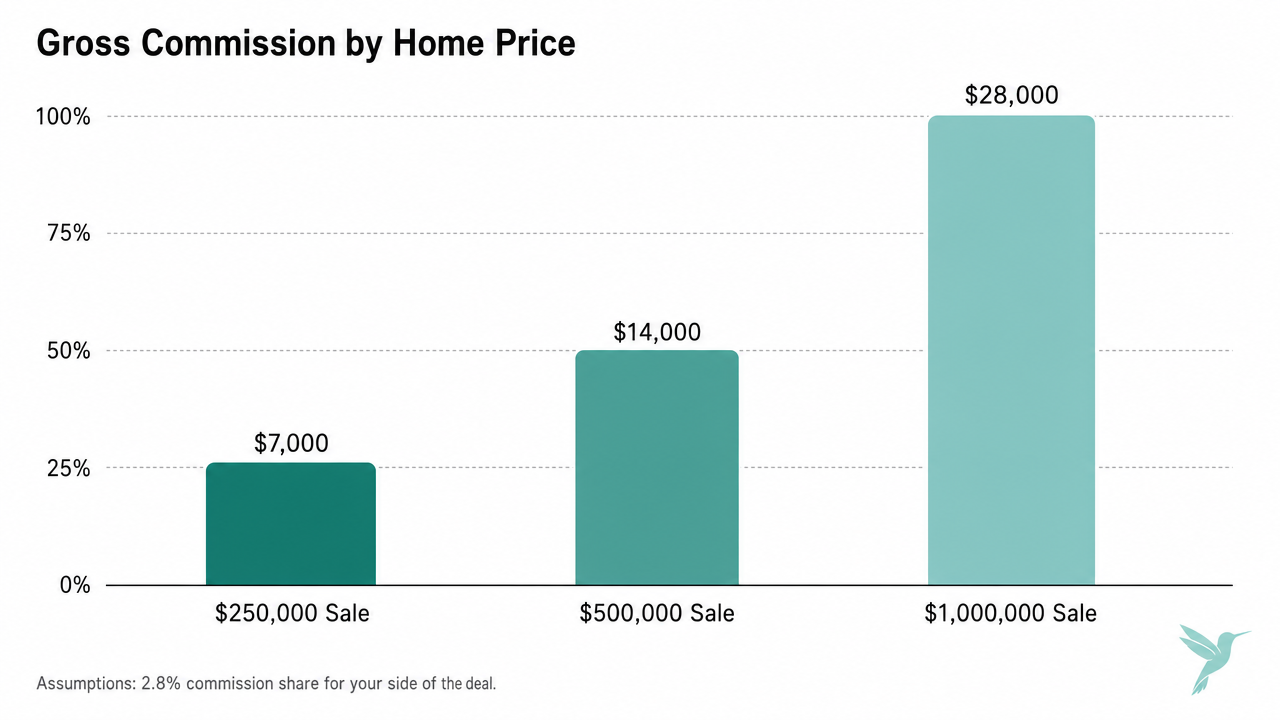
Earnings tend to climb as your experience and deal volume grow.
Income Trends
While incomes can vary widely for new agents, your earning potential grows significantly with experience. Here’s what you can expect at different stages of your career based on our alumni surveys:
- 1 to 3 Years in Real Estate: Earnings vary for new agents. Some start under $25,000, while others quickly break into six figures. In fact, roughly 1 in 4 of our surveyed alumni report earning $100,000 or more within their first three years.
- 4 to 10 Years in Real Estate: This is where experience really starts to pay off. Earnings often concentrate in the $50,000 to $150,000 range, and about one-third of our surveyed alumni report earning $200,000 or more.
- 11 to 25 Years in Real Estate: At this stage, six-figure incomes become the new normal. Nearly half of our surveyed alumni in this range report earnings between $100,000 to $149,000, with many surpassing $200,000 annually.
This data proves that with dedication, your real estate career can become increasingly lucrative over time, offering limitless potential for financial success.
Learn more about real estate agent income by downloading our latest Salary Guide. This guide details the earnings of our alumni agents at every stage of their careers.
Download the Latest Salary Guide Now
Understanding Average Commission Rates and Regional Variations
Real estate is local, and so are commission rates. While the national average hovers near 5.5%, regional variations are common due to local laws, cost of living, and competition.
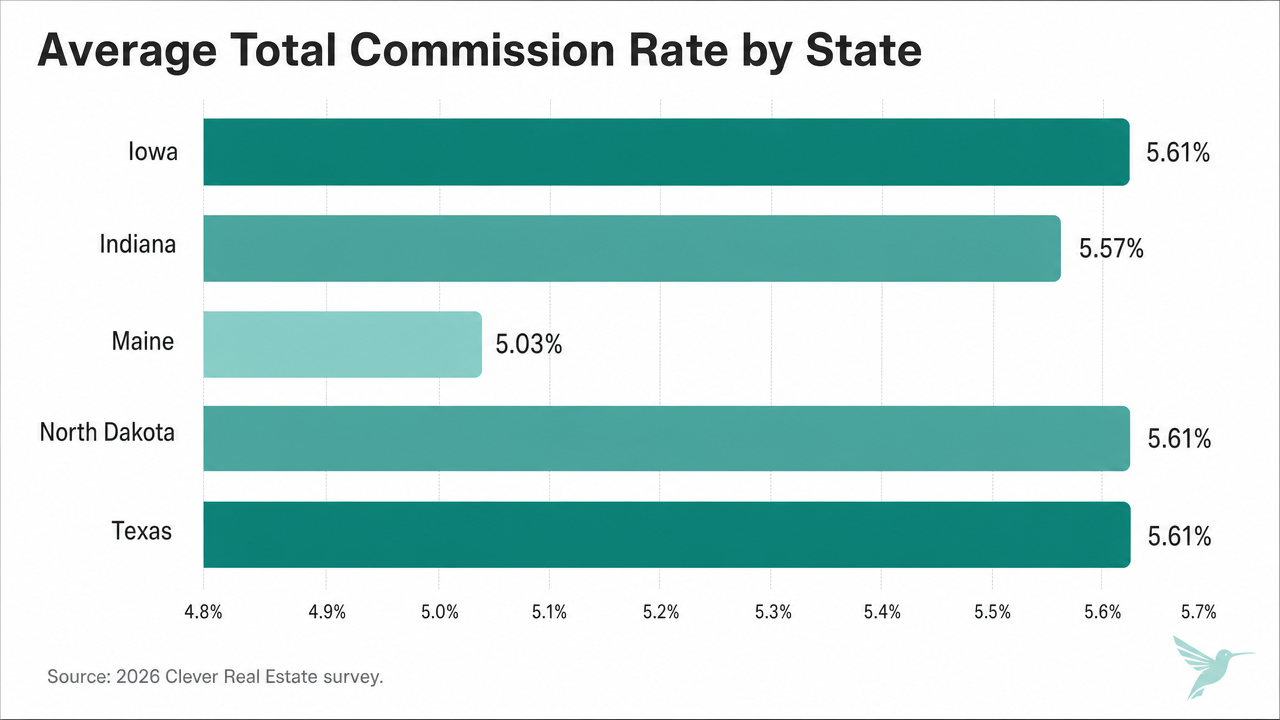
According to Clever Real Estate’s 2026 survey, here is how average total commission rates compare across selected states:
State | Avg. Total Commission |
|---|---|
Iowa | 5.61% |
Indiana | 5.57% |
Maine | 5.03% |
North Dakota | 5.61% |
Texas | 5.61% |
Data source: 2026 Clever Real Estate survey. Rates are subject to negotiation and change. For a deeper look at how rates are set and trending, see our guide to the average real estate commission.
Average Total Commission Rate by State
Step 3: Calculate Real Estate Commission Based on Sales
Planning your financial future requires accurate forecasting. Using a real estate commission calculator can help you set specific sales goals.
How to Calculate Your Earnings
The formula is simple: (Sales Price × Commission Rate) ÷ 100 = Gross Commission
If you want to dive deeper, you can simulate different scenarios. For example, if you are considering joining a flat-fee brokerage versus a traditional commission-split brokerage, run the numbers on your expected sales volume. If you plan to sell 10 homes a year, a flat monthly fee might save you thousands compared to giving up 30% of every deal.

Run the numbers on your expected sales volume before you commit to a brokerage model.
Use this Commission Calculator to Learn How Much You Can Make
Step 4: Increase Your Real Estate Commission Salary by Learning More
One of the best ways to boost your real estate agent salary is through education. The more you know, the more value you provide, and the more clients you attract.
Certifications and Trainings That Pay Off
Earning a specialist designation can open doors to niche markets with higher price points.
By completing these professional development trainings and earning specialized certifications, you’ll not only enhance your professional credibility but also distinguish yourself in a competitive market. Here’s a quick summary of the certifications and trainings that can take your career to the next level:
- Real Estate Negotiation Institute (RENI): Master advanced negotiation tactics and communication strategies to close deals effectively and satisfy clients. RENI offers unparalleled training that covers the entire transaction lifecycle, helping you gain a competitive edge.
- Institute for Luxury Home Marketing: Transform your career in luxury real estate by learning how to market high-end properties and connect with affluent clientele. Join an exclusive network of luxury agents while elevating your earning potential in this lucrative sector.
- Real Estate AI Specialist (REAIS): Stay ahead in the tech-driven market with this certification. Learn how to integrate AI tools into your business to automate processes, serve clients more efficiently, and build trust, all while maintaining compliance with industry standards.
- Survive & Thrive Real Estate Course: Designed for newly licensed agents, this program provides essential strategies, systems, and scripts to land clients quickly and avoid common early setbacks. Build confidence, a solid lead generation plan, and a roadmap to success in your first 90 days.
By getting a Continuing Education (CE) membership, you can access these career-changing certifications and trainings at a fraction of the cost. Invest in your professional development and watch your career soar!
Recent and Potential Changes in Commission Models
The real estate industry is currently navigating significant changes following the 2024 NAR settlement. It’s vital for new agents to stay informed.
- Changes to MLS Rules: Offers of compensation for buyer’s agents can no longer be displayed on Multiple Listing Services (MLS). This encourages transparency on how real estate agents get paid.
- Written Agreements: Agents working with buyers must now enter into written agreements before touring a home. This clarifies the negotiated fees and services provided.
- Consumer Choice: These changes aim to increase transparency regarding buyer’s agent fees and negotiated fees, ensuring consumers understand exactly what they are paying for when hiring a real estate professional.
Despite these shifts, data shows that buyer’s agent commissions have remained relatively stable. This suggests that sellers still see the value in incentivizing buyer’s agents to bring qualified buyers to the table.
Frequently Asked Questions and Common Concerns
Are Real Estate Commissions Negotiable?
Yes. Commission rates are not fixed by law and are fully negotiable between agents and their clients. You have the flexibility to adjust your rates based on the services you provide.
Is the Commission Included in Closing Costs?
Yes, commissions are typically paid at closing and are deducted from the proceeds of the sale (for sellers) or added to the closing costs (if paid by the buyer).
Can I Save Money With a Flat-Fee Brokerage?
Yes. Flat-fee brokerages charge a set rate for listing services rather than a percentage. This can help sellers save money and enable agents to offer competitive pricing models.
How Much Does a Real Estate Agent Make on a $300,000 Home?
At roughly 2.8% for your side of the deal, a $300,000 home earns about $8,400 in gross commission. That figure is before your brokerage split, taxes, and business expenses come out, so your take-home will be lower.
How Much Does a Real Estate Agent Make on a $500,000 Home?
At about 2.5% to 3% for your side, a $500,000 home earns roughly $12,500 to $15,000 in gross commission. Your brokerage split, taxes, and expenses then reduce that amount to your actual take-home pay.
Achieve Your Goals in Real Estate with Colibri Real Estate School

Thinking about a career in real estate and wondering how it can transform your financial future? Colibri Real Estate is here to guide you every step of the way. Start by downloading our free Real Estate Agent Salary Guide and discover what top-earning agents are making, even in their first year.
With our flexible pre-licensing courses, tailored payment plans, and industry-leading career resources, you’ll have everything you need to launch a successful and profitable career. Join the 1.5M students who trust Colibri Real Estate to help them achieve financial independence faster.
Have questions? Contact us via chat, phone, or email, and a member of our support or enrollment team will be happy to assist you. Don’t wait, take this opportunity to invest in your future today.
Disclaimer: This guide is for general informational purposes only, based on a September 2025 survey of Colibri Real Estate School alumni and publicly available industry sources. While Colibri Real Estate School strives for accuracy, we make no guarantees regarding the completeness, reliability, or applicability of the information. Earnings and outcomes vary widely based on factors like location, experience, and market conditions and should not be considered guarantees. This guide does not constitute professional advice. Users should consult additional sources for personalized guidance.


