
A real estate broker is a licensed professional who has met additional education and experience requirements beyond a real estate agent. That’s the core difference: a broker can work independently, run a brokerage, and supervise agents. An agent, by contrast, has to work under a broker’s license.
This guide covers what a real estate broker does, how the role differs from an agent, and the main types of brokers. You’ll also see how both roles get paid, how to become a broker, and which path fits the career you want to build.
Table of Contents
- What Does a Real Estate Broker Do?
- What Is a Real Estate Agent?
- Real Estate Broker vs. Real Estate Agent: Key Differences
- Types of Real Estate Brokers
- How Real Estate Brokers and Agents Get Paid
- How to Become a Real Estate Broker
- Agent, Broker, or REALTOR®?
- Frequently Asked Questions
- Interested in Getting Started With Real Estate?
Key Takeaways
- Most brokers start as agents: States typically require agent experience and additional formal training before a broker license (U.S. Bureau of Labor Statistics).
- Agents work under a broker: Sales agents must work with a broker, while brokers can run their own firms (U.S. Bureau of Labor Statistics).
- Brokers tend to earn more: The median wage was $73,220 for brokers versus $52,830 for sales agents in May 2025 (U.S. Bureau of Labor Statistics).
- Titles vary by state: Illinois licenses a broker and a separate managing broker, so check your state’s terms (Illinois Department of Financial and Professional Regulation, Division of Real Estate).
- REALTOR® is a membership: A REALTOR® belongs to a voluntary membership organization, the National Association of REALTORS®, and it isn’t a separate license level (Texas Real Estate Commission).
What Does a Real Estate Broker Do?
A real estate broker is a licensed professional who has completed additional coursework, passed a broker exam, and earned a broker license. That extra qualification lets a broker operate without supervision. A broker can open a brokerage, hire agents, and oversee their work (U.S. Bureau of Labor Statistics).
Brokers still help clients buy and sell property, just like agents do. The difference: a broker can also oversee other licensees and manage the business side of real estate.
Keep one distinction straight: the broker is the licensed person, while the brokerage is the company that person runs or works for. A broker’s duties typically include the following (U.S. Bureau of Labor Statistics; Illinois General Assembly):
- Overseeing and training the agents they sponsor
- Hiring agents for the brokerage
- Preparing documents such as purchase agreements and leases
- Making sure purchase contract terms are met
- Handling the business details of running an office
- Representing buyers and sellers directly
What a Broker Can Do That an Agent Can’t
Real estate brokers are licensed to manage their own businesses, while sales agents must work with a broker (U.S. Bureau of Labor Statistics). In Texas, for example, sales agents must be sponsored by a broker and work with clients on behalf of that broker (Texas Real Estate Commission). That license gap gives a broker four abilities an agent doesn’t have:
- Practicing independently, without a supervising broker
- Opening and running a brokerage
- Hiring and overseeing agents
- Running a firm that shares in agents’ commissions, which are often divided among agents, brokers, and firms (U.S. Bureau of Labor Statistics)
If you’re not licensed yet, these broker abilities come later. Sales agents typically advance to a broker license after gaining experience, so most careers start with an agent license earned through state-approved pre-licensing education (U.S. Bureau of Labor Statistics).
What Is a Real Estate Agent?
A real estate agent is a licensed professional who represents buyers and sellers in property transactions. An agent helps clients price homes, tour listings, negotiate offers, and close deals. Agents earn commission on the transactions they complete.
The key limit: an agent must work with a licensed broker, who oversees the agent’s work (U.S. Bureau of Labor Statistics). In some states, an agent needs a sponsoring broker while getting licensed. Agents typically advance to a broker license after gaining experience (U.S. Bureau of Labor Statistics).
After you earn your license, your next step is choosing a sponsoring brokerage to work under.

An agent’s day-to-day: guiding clients through showings, offers, and closings.
Real Estate Broker vs. Real Estate Agent: Key Differences
Whether you become an agent or a broker, you’ll do the same core work: helping people buy and sell property. What sets the two roles apart is licensing, independence, responsibility, and pay. Here’s how they compare across the four differences that matter most as you plan your career.
Requirements
Most brokers start out as licensed agents, but not all agents become brokers (U.S. Bureau of Labor Statistics). To move up, an agent completes additional coursework, passes a broker exam, and earns a separate license. Each state sets its own rules.
Most states require at least 2 years of experience as a licensed sales agent to qualify for a broker license (U.S. Bureau of Labor Statistics).
In Florida, broker applicants generally must complete 72 hours of approved pre-licensure broker education, pass a licensure examination, and submit to a background check (plus fingerprinting). Most applicants also need at least 24 months as an active sales associate during the preceding 5 years, though DBPR lists alternate experience routes (Florida Real Estate Commission, DBPR, “Sales Associate to Broker”). Check the commission’s current rules before you apply.
Colibri’s broker license courses walk you through the coursework and exam prep for your state.
Level of Independence
As an agent, you must work with a broker who oversees your work, and commissions are often divided among agents, brokers, and firms (U.S. Bureau of Labor Statistics). A broker doesn’t carry that constraint. Brokers can work independently, join a firm, or run their own brokerage.
That independence is the practical payoff of the extra licensing. It also comes with more responsibility, because a broker oversees the work of the agents under them (U.S. Bureau of Labor Statistics).
Duties
As an agent, you advise clients through transactions: pricing, showings, offers, and closings. A broker can do all of that too. On top of client work, a broker supervises agents and runs the brokerage’s day-to-day operations.
That includes handling business details, preparing documents such as purchase agreements, and hiring and training agents (U.S. Bureau of Labor Statistics; Illinois General Assembly). So if you become a broker, your job blends front-line deal-making with running a business.
Salary & Earning Potential
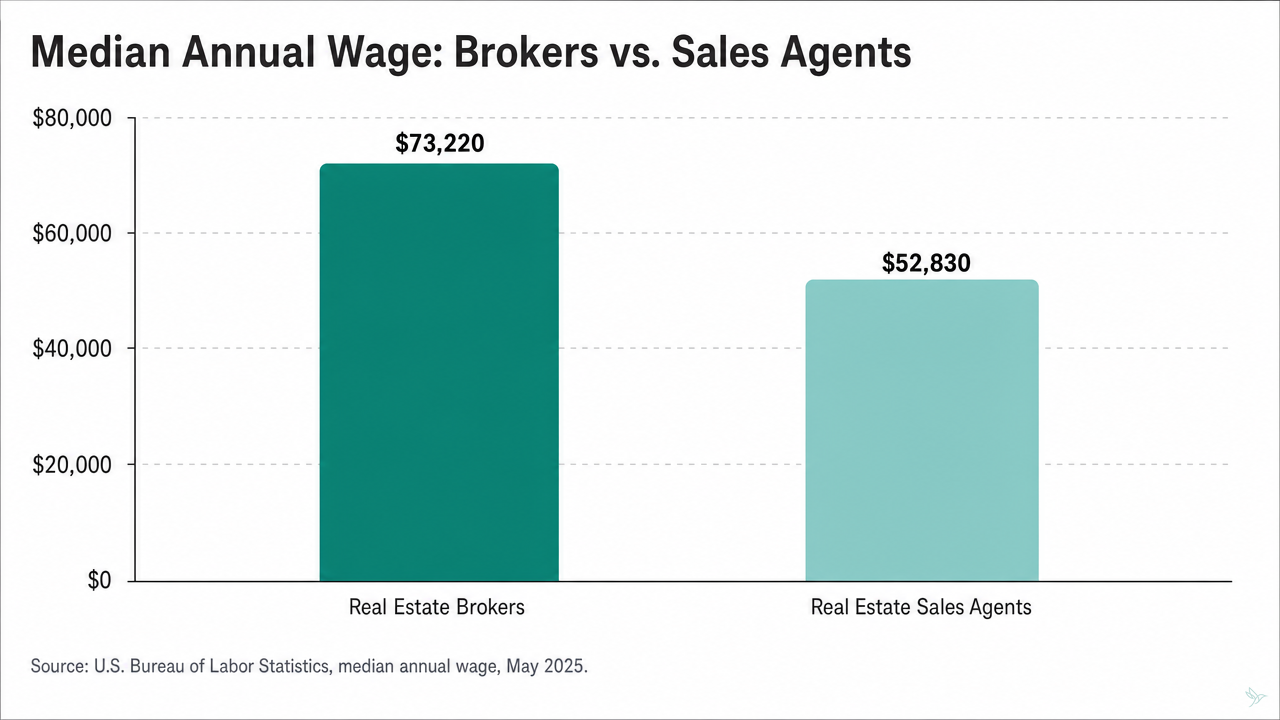
Median Annual Wage: Brokers vs. Sales Agents. Source: U.S. Bureau of Labor Statistics, May 2025.
Brokers tend to have greater earning power. They can run their own firms, and commissions are often divided among agents, brokers, and firms (U.S. Bureau of Labor Statistics).
In May 2025, the median annual wage was $73,220 for brokers and $52,830 for real estate sales agents (U.S. Bureau of Labor Statistics). These figures exclude self-employed workers, and many brokers and agents are self-employed, so treat the medians as a benchmark.
Your actual pay depends on your market, hours, and commission split. To compare figures by role and state, download the salary guide from our real estate salary guide page.
One note on titles: the words don’t line up the same way in every state. Illinois, for example, licenses a “broker” and a separate “managing broker” (Illinois Department of Financial and Professional Regulation, Division of Real Estate).
Types of Real Estate Brokers
Not every broker does the same job. Broker titles describe different levels of responsibility, and the exact terms vary by state. Here are the three you’ll hear most often:
- Designated broker: In Illinois, a designated managing broker supervises the activities of licensees and trains the licensees the firm sponsors (Illinois General Assembly).
- Managing broker: Some brokers manage an office within a real estate company, with duties such as hiring, training, and assisting sales agents (U.S. Bureau of Labor Statistics). Illinois issues a separate managing broker license (Illinois Department of Financial and Professional Regulation, Division of Real Estate).
- Associate broker or broker associate: The meaning depends on the state. In Florida, a broker associate qualifies for a broker license but works as a sales associate for another broker (Florida Real Estate Commission, DBPR, “Florida Real Estate Commission”). BLS uses associate broker for brokers who manage an office within a company (U.S. Bureau of Labor Statistics).
Confirm the exact titles your state uses before you plan your path. The same word can mean different things across state lines, so check your state authority’s language first.
How Real Estate Brokers and Agents Get Paid
Whether you work as an agent or a broker, you earn primarily through commission on the transactions you close (U.S. Bureau of Labor Statistics). As an agent, you often work for a broker on contract and keep a portion of each sale’s commission (U.S. Bureau of Labor Statistics). A broker can earn commission on their own deals, and commissions are often divided among agents, brokers, and firms (U.S. Bureau of Labor Statistics).
That gives a broker who runs a firm more than one way to earn, and the BLS median wage for brokers is higher than for agents. Commission splits vary by brokerage and agreement, so read the terms before you sign on.
Here’s a hypothetical example using illustrative numbers, not market rates. On a $10,000 commission at a 70/30 split, the agent keeps $7,000 and the brokerage keeps $3,000. To test the split you’re offered, plug your own numbers into Colibri’s real estate commission calculator.
The takeaway for you: as an agent, you earn on your own deals; as a broker running a firm, you can also share in the commissions divided with your agents.
How to Become a Real Estate Broker
Becoming a broker follows a clear sequence. Here’s the path from agent to broker:
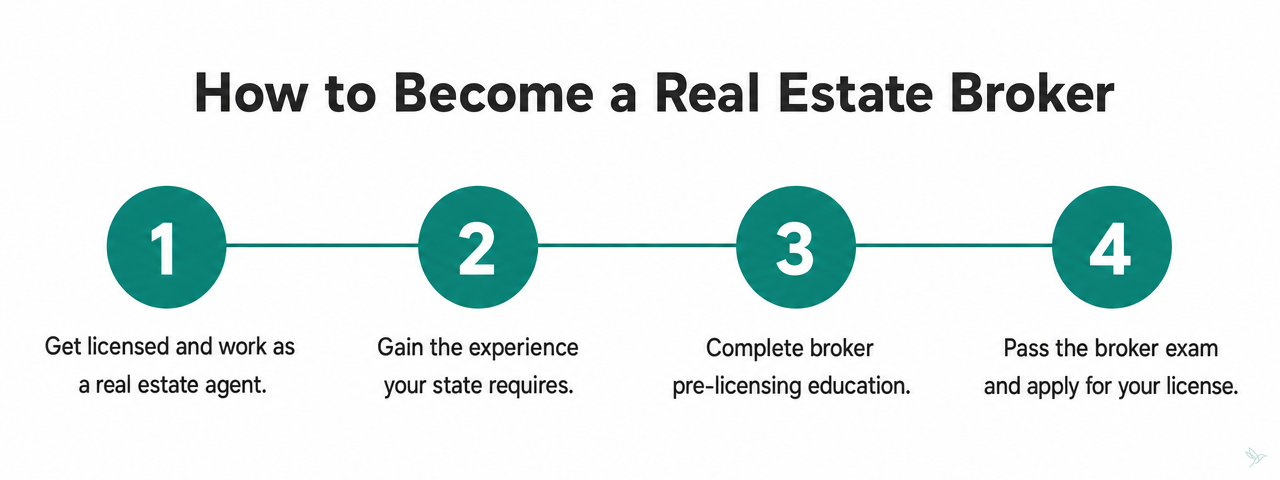
- Get licensed and work as a real estate agent.
- Gain the experience your state requires, often at least 2 years as a licensed sales agent (U.S. Bureau of Labor Statistics).
- Complete broker pre-licensing education.
- Pass the broker exam and apply for your broker license.
The path ends with passing the broker exam and earning your broker license.
For a step-by-step roadmap, see our guide on how to become a real estate broker.
Agent, Broker, or REALTOR®?
A REALTOR® isn’t a license at all. It’s a person in the real estate business who belongs to the National Association of REALTORS® (Legal Information Institute, Cornell Law School), a voluntary membership organization (Texas Real Estate Commission).
Not all license holders are REALTORS®, and agents and brokers can both be members, so it’s a membership, not a rank above broker (Texas Real Estate Commission). For a side-by-side look, read our comparison of agent vs. REALTOR®.
Frequently Asked Questions
Is a Real Estate Broker Higher Than an Agent?
A broker license typically requires years of experience as a sales agent plus additional formal training (U.S. Bureau of Labor Statistics). But a higher license isn’t automatically a better fit for you. The right choice depends on whether you want to run a business or focus on serving clients.
Who Gets Paid More, a Broker or an Agent?
Brokers’ median wage is higher (U.S. Bureau of Labor Statistics). Still, your pay depends on your role, your market, and your commission split. Plenty of agents out-earn plenty of brokers.
How Do Real Estate Brokers Make Money?
Brokers earn commission on their own transactions. Agents who work for a broker often earn a portion of each sale’s commission, and commissions are often divided among agents, brokers, and firms (U.S. Bureau of Labor Statistics).
Can a Real Estate Agent Work Without a Broker?
No. Sales agents must work with a licensed broker (U.S. Bureau of Labor Statistics). That broker oversees the agent’s work, and in some states an agent needs a sponsoring broker while getting licensed.
Do You Need to Be an Agent Before Becoming a Broker?
In most states, yes. Broker candidates usually need experience as a licensed sales agent, often at least 2 years (U.S. Bureau of Labor Statistics). Check your state’s exact requirement before you plan your timeline.
Is a Broker the Same as a REALTOR®?
No. A REALTOR® belongs to a voluntary membership organization, which is different from a license level, and not all license holders are REALTORS® (Texas Real Estate Commission). Agents and brokers can both hold REALTOR® membership.
Interested in Getting Started With Real Estate?

In most states, you start with an agent license and can pursue a broker license once you have the required experience (U.S. Bureau of Labor Statistics). Colibri Real Estate is trusted by 1.5M+ alumni nationwide, with guided, state-specific pre-licensing courses to help you start. Here’s how to take your first step:
- Pick your state and confirm its pre-licensing requirements.
- Get started with your real estate license and enroll in a guided course.
- Start your pre-licensing coursework this week and work toward your exam.
If you want to know what the agent role involves first, our guide on how to become a real estate agent shows what to expect.
Sources
- U.S. Bureau of Labor Statistics. “Real Estate Brokers and Sales Agents.” Occupational Outlook Handbook, U.S. Department of Labor, last modified August 27, 2026, https://www.bls.gov/ooh/sales/real-estate-brokers-and-sales-agents.htm.
- Florida Real Estate Commission, DBPR. “Florida Real Estate Commission.” Florida Department of Business and Professional Regulation, accessed October 2, 2026, https://www2.myfloridalicense.com/real-estate-commission/.
- Florida Real Estate Commission, DBPR. “Sales Associate to Broker (RE 2) Checklist.” Florida Department of Business and Professional Regulation, accessed October 2, 2026, https://www.myfloridalicense.com/CheckListDetail.asp?SID=&xactCode=1014&clientCode=2501&XACT_DEFN_ID=806.
- Illinois Department of Financial and Professional Regulation, Division of Real Estate. “Real Estate Brokerage.” IDFPR, accessed October 2, 2026, https://idfpr.illinois.gov/profs/realest.html.
- Illinois General Assembly, Joint Committee on Administrative Rules. “Section 1450.705 Designated Managing Broker Responsibilities and Supervision.” Illinois Administrative Code, Title 68, accessed October 2, 2026, https://ilga.gov/commission/jcar/admincode/068/068014500G07050R.html.
- Texas Real Estate Commission. “Consumer Guide to the Texas Real Estate Commission.” trec.texas.gov, accessed October 2, 2026, https://www.trec.texas.gov/public/consumer-information.
- Legal Information Institute, Cornell Law School. “Realtor.” Wex, last reviewed November 2020, https://www.law.cornell.edu/wex/realtor.


